
Presented by
Wm. Max Miller,
M. A.
Click on Anubis to learn about our logo and banners.
Project Updates
Quickly Access Specific Mummies With Our Or XVII'th XVIII'th
Gallery II
See what's new at the T. R. M. P.
Mummy Locator
View mummies in the
following Galleries:
Dynasty
Dynasty
Including the mummy identified as Queen Hatshepsut.
Gallery III
Including the mummy identified as Queen Tiye.
Gallery
IV
Featuring the controversial KV 55
mummy. Now with a revised reconstruction of ancient events in this perplexing
tomb.
Gallery V
Featuring the mummies of Tutankhamen and his children.
Still in preparation.
XIX'th
Dynasty
Gallery I
Now including the
mummy identified as
Ramesses I.
XX'th
Dynasty
XXI'st
Dynasty
21'st Dynasty Coffins from DB320
Examine the coffins
of 21'st Dynasty Theban Rulers.
Unidentified Mummies
Gallery I
Including the mummy identified as Tutankhamen's mother.
About the Dockets
Inhapi's Tomb
Using this website for research papers
Acknowledgements
Links to Egyptology websites
Biographical Data about William Max Miller
Special Exhibits
The Treasures of Yuya and Tuyu
View
the funerary equipment of Queen Tiye's parents.
Tomb
Raiders of KV 46
How thorough were the robbers who plundered the tomb of
Yuya and Tuyu? How many times was the tomb robbed, and what were the thieves
after? This study of post interment activity in KV 46 provides some answers.
Special KV 55 Section
========
Follow the trail of the missing treasures from mysterious KV 55.
KV
55's Lost Objects: Where Are They Today?
The KV 55 Coffin Basin
and Gold Foil Sheets
KV 55
Gold Foil at the Metropolitan
Mystery of the Missing Mummy Bands
KV
35 Revisited
See rare photographic plates of a great
discovery from Daressy's Fouilles de la Vallee des Rois.
Unknown Man E
Was he really
buried alive?
The
Tomb of Maihirpre
Learn about Victor Loret's
important discovery of this nearly intact tomb in the Valley of the Kings.
Special Section:
Tomb Robbers!
Who were the real tomb raiders?
What beliefs motivated their actions? A new perspective on the ancient practice
of tomb robbing.
Special Section:
Spend a Night
with the Royal Mummies
Read Pierre Loti's eerie account of
his nocturnal visit to the Egyptian Museum's Hall of Mummies.
Special Section:
An
Audience With Amenophis II Journey
once more with Pierre Loti as he explores the shadowy chambers of KV 35 in the
early 1900's.

Most of the images on this website have been
scanned from books, all of which are given explicit credit and, wherever
possible, a link to a dealer where they may be purchased. Some images derive
from other websites. These websites are also acknowledged in writing and by
being given a link, either to the page or file where the images appear, or to
the main page of the source website. Images forwarded to me by individuals who
do not supply the original image source are credited to the sender. All written
material deriving from other sources is explicitly credited to its author.
Feel free to use material from the Theban Royal Mummy Project website.
No prior written permission is required. Just please follow the same guidelines
which I employ when using the works of other researchers, and give the Theban
Royal Mummy Project proper credit on your own papers, articles, or
web pages.
--Thank You

This website is constantly developing and contributions
of data from other researchers are welcomed.
Contact The Theban Royal Mummy Project at:
anubis4_2000@yahoo.com
Background Image: Wall scene from the tomb of Ramesses II (KV 7.) From Karl
Richard Lepsius, Denkmäler (Berlin: 1849-1859.)


XVII'th Dynasty Gallery I
Go here for a history of the
17'th Dynasty
Unknown Woman B (Tetisheri?)
(c. 1633 B.C.)
17'th Dynasty
Provenance:
DB 320
Discovery Date: 1881
Current Location: Cairo Museum CG61056

Biographical data
Details
: The identity of this mummy and the circumstances surrounding its discovery in DB 320 are unclear. There is some evidence that this mummy and another one, which had been tentatively identified by Maspero as Ramesses I, may have been mixed up between 1886 and 1909. On the latter date, G. E. Smith was preparing to unwrap the mummy alleged to be that of Ramesses I, but states that "...when I opened the coffin in June, 1909, I found the mummy of a naked woman, embalmed in the manner distinctive of the earlier part of the XVIII'th Dynasty." Either Maspero mistook the female mummy as a male when he first examined it in 1886, or the male mummy which he identified as Ramesses I was somehow replaced with the female mummy. (Many experts now believe that the mummy of Ramesses I is the mummy from the Niagara Falls Museum, which left Egypt in 1860. For more on the missing mummy of Ramesses I, see the IX'th Dynasty Gallery on the navigation bar at left.) Smith gave the female mummy the designation "Unknown Woman B" but others have tried to give her a more definite identity. Daressy and Murray both noted that bandages, which were associated in some fashion with this mummy, had been inscribed with the name of Tetisheri, and some researchers identify the mummy as that of this 17'th Dynasty queen (contra Smith's 18'th Dynasty dating of the mummy.)The mummy itself is that of an old woman, whose thinning white hair had been interwoven with the hair of a wig in order to conceal her almost complete baldness. Smith noted that her ears had been pierced, and also commented on her protruding upper teeth, a characteristic which he noted in the mummies of Nofritari and Lady Rai. He also noted that thieves had damaged the body: the head had been broken off, and the right hand was missing.
Whether the mummy had been found in a coffin or near fragments of a coffin originally belonging to Ramesses I remains unclear. (Source Bibliography: AE, [1934], 69; ASAE 9, [1908], 137; CCR, 26 ff.; MiAE, 118, 316, 321; MR, 551-552, 582 [6]; RM, 14-15; XRA, 4A2-8; XRP, 120-121.)
Other Burial Data:
Original Burial: Undetermined.
Reburials: Reeves places the mummy of Unknown Woman B in the k3y of
Inhapi along with the other mummies which were cached in this tomb. He dates her
removal to DB 320 to sometime after Year 11 of
Shoshenq I. (Source:
DRN, 250.)
Photo Credit: RM, (Cairo, 1912,) pl. IX.
For high resolution photos of "Tetisheri" see the University of Chicago's
Electronic Open Stacks copy of Smith's The Royal Mummies (Cairo, 1912,)
Call #: DT57.C2 vol59, plate
IX and
X.

Seqnenre-Taa II
(c. 1574 B.C.)
Provenance:
DB 320
Discovery Date:1881
Current Location: National Museum of Egyptian Civilization in Fustat CG61051
Biographical data

Details: The mummy of Seqnenre-Taa II was partly unwrapped by Gaston Maspero on June 9'th, 1886. G. E. Smith completed the task on September 1'st, 1906. The mummy displayed some highly unusual (and visibly prominent) injuries which caused Maspero to theorize that Seqnenre-Taa II was killed in battle. Since this king ruled during the struggle to overthrow and expel the Hyksos, Maspero's explanation of his massive head injuries seems plausible. Dr. Fouquet, who also examined the mummy, argued that its condition could be largely explained as the result of natural decomposition which may have occurred during
a period of time in which the ruler was being transported to Thebes in order to be embalmed. Smith completely disagrees with Fouquet, whose evaluation of the mummy is difficult to understand given the evident head injuries which it had sustained. The king had apparently been stabbed behind one of his ears with a knife or sword. His cheek and nose had been smashed, perhaps with a mace, and the large wounds visible above the king's right eye and on his upper forehead may have been inflicted with a battle axe.All of these injuries seem consistent with the kind of battlefield death one might easily imagine for the king who led his countrymen in rebellion against their Hyksos overlords. But Ikram and Dodson refer to a recent examination of the wound behind the king's ear which revealed that this injury had started to heal prior to the king's death, and therefore indicated that Seqnenre-Taa II had received it well in advance of the time when the other wounds to his head were inflicted. They mention the possibility that the king may have been injured in battle, and then assassinated while he was still recuperating. This is also plausible: even at the court in Thebes, where Seqnenre-Taa II ruled, there must have been Hyksos infiltrators and supporters who would want to eliminate any opposition to Hyksos domination.
The rest of Seqnenre-Taa II's body was poorly preserved. No attempt had been made to straighten out the king's arms, which still remain frozen in the position he adopted in his futile attempt to shield himself from lethal blows. The embalmers who removed the internal organs packed the body with linen. They also took out the heart, an important organ which was typically left in place in Egyptian mummies. The Egyptians believed that the heart was the seat of the personality, and its preservation within the body was of great significance in the traditional funerary beliefs. Exactly why the heart of Seqnenre-Taa II was removed remains unknown. Perhaps the embalmers were hurried in their work, and simply performed the evisceration carelessly. But perhaps the king's heart was removed intentionally in a magical attempt to destroy him in the afterlife. The brain, an organ usually removed by the embalmers, was left in place.
Smith describes the king's bones as being disarticulated, and commented on the pliable nature of the skin which still covers them in places. He also mentioned that the mummy emits a pleasant scent produced by the aromatic powdered wood which had been sprinkled over the body.
 Seqnenre-Taa II was found in his original coffin (CG61001 See photo at left.). The royal
uraeus and eye inlays had been removed, and most of the gilding had been scraped
off. Reeves comments that the inscriptions and symbolic elements had been
"preserved and restored." This had obviously been done by restorers, who had
also probably carefully stripped the coffin of its gilding. But the fact that
some of the inscriptions needed to be restored (as opposed to being preserved)
may indicate that thieves had gotten to the coffin at some point in time and
damaged the inscriptions in some manner. (See Other Burial Data below.)
Seqnenre-Taa II was found in his original coffin (CG61001 See photo at left.). The royal
uraeus and eye inlays had been removed, and most of the gilding had been scraped
off. Reeves comments that the inscriptions and symbolic elements had been
"preserved and restored." This had obviously been done by restorers, who had
also probably carefully stripped the coffin of its gilding. But the fact that
some of the inscriptions needed to be restored (as opposed to being preserved)
may indicate that thieves had gotten to the coffin at some point in time and
damaged the inscriptions in some manner. (See Other Burial Data below.) (Source Bibliography: CCR, 1f; DRN, 202, 208, 214, 250; MR, 526ff; MiAE, 117-118; RM, 1ff; XRA, 1A2; XRP, 122ff.)
Other Burial Data:
Original Burial: Ikram and Dodson place the original pyramid tomb of
Seqnenre-Taa II in Dra Abu'l-Naga, along with the burials of other 17'th Dynasty
rulers.
Official Inspections/Restorations: The Papyrus Abbot records an official
inspection of the tomb of Seqnenre-Taa II on Year 16, 3 3ht 18 of
Ramesses IX. The tomb was found to be intact at that time. However, it was
probably robbed at some point between this date and the transferal of
Seqnenre-Taa II into DB 320. For the most part, Reeves takes it as axiomatic
that the restorers would only move a mummy to another tomb if it had already
been robbed. Also, as noted above, some of the inscriptions on Seqnenre-Taa II's
coffin had been restored. Apparently, they had been somewhat damaged at an
earlier date. Damaged inscriptions, whenever they occur and are not obviously
examples of damnatio memori, may be interpreted as the work
of tomb robbers whose methods of stripping a coffin were presumably not as
careful as those used by the restorers. Based on the testimony of the Papyrus
Abbot, we know that Seqnenre-Taa II's burial was intact at least until Year
16 of Ramesses IX. The most likely date for a disturbance of his burial would
probably be during the troubled years of Ramesses XI when a documented wave of
tomb plundering took place. Reeves places him in the k3y of his wife
Inhapi (which he identifies as WN A) where other royal mummies were cached, and
dates his transference from this tomb into DB 320 to a time after Year 11 of
Shoshenq I. (Source
Bibliography: DRN, 250 .)
Photo Credit: color photos from Patrick Landmann/science Photo Library; photo of coffin from Alda Culumaron/Pinterest. For high resolution photos of
Seqnenre-Taa II see the University of Chicago's Electronic Open Stacks copy of
Smith's The Royal Mummies (Cairo, 1912,) Call #: DT57.C2 vol59,
plates
I,
II, and
III. To learn more about Seqnenre-Taa II and his battle with the Hyksos, read Gary Shaw’s article, “The Curious Tale of King Seqenenre-Tao” in RAWI's ISSUE 4, 2013 .

Ahmose-Inhapi
(c. 1574 B.C.)
17'th Dynasty
Provenance:
DB 320
Discovery Date: 1881
Current Location: Cairo Museum CG61053
Biographical data
Details: The mummy of Inhapi was discovered at a
position which Reeves locates near the entrance of corridor B in DB 320 (click
here to see
tomb diagram.) It was unwrapped by Gaston Maspero on June 20'th, 1886.
Smith, who examined it at a much later date, remarked its similarity to the
mummy of Seqnenre-Taa
II (see above.) For although Inhapi had been carefully embalmed, her body
had not been preserved any better than that of her hastily mummified husband.
Smith hypothesized that the techniques of mummification employed for Inhapi
probably represented the best which the Egyptian embalmers could provide at the
end of the 17'th Dynasty.
The mummy itself was wrapped in a shroud and had a floral garland around the
neck. Smith describes the mummy as that of a "big, strongly built woman." He
notes that the body had been laid out in the conventional position, with the
arms placed vertically at the sides. The skin was dark brown, "soft, moist and
tough, like oiled leather." Smith called attention to the over-all similarity of
Inhapi's mummy to mummies of the much later Coptic period, but notes that the
embalming incision clearly distinguishes it from mummies of the Christian era.
Curiously, and in spite of the incision, some of the pelvic organs are still in
place. Smith attributes Inhapi's facial distortions to the shrinkage of
subcutaneous tissues and also to the fact that some type of object had been
pressed into the swollen skin. He surmises that this object may have been a
pectoral ornament. Smith notes that, as in the case of Seqnenre-Taa II, aromatic
powdered wood had also been sprinkled over Inhapi's body. He also comments on
the manner in which Inhapi's hair had been plaited in a style which dates her
mummy to the early New Kingdom.
The mummy of Inhapi was found in the original outer coffin of the Lady Rai,
a wet-nurse of Ahmose-Nofretiri (see photo of coffin below left.) This coffin (CG61004) had its gilding adzed off and eye
inlays removed. Reeves notes that in spite of the coffin's stripping, probably
at the hands of the restorers, the symbolic figures of Isis and Nepthys at the
foot remain intact. (Source Bibliography: CCR, 4ff.; DRN, 200,
206, 214; MR, 530ff.; RM, 8-11.)

 Other Burial Data:
Original Burial: Herbert Winlock and Elizabeth Thomas both believed that the
original tomb of Inhapi (referred to in the dockets as the k3y, or "high
place") was DB 320, the cache tomb in which her body was found. Reeves,
however, contends that this view is incorrect since it is not based on an
adequate consideration of the physical evidence found in DB 320. Based on his
reconstruction of the position of the coffins at the time of their discovery in
DB 320, Reeves argues that this tomb could not possibly be the k3y of
Inhapi, and contends that WN A was Inhapi's original place of burial. (For more
about Inhapi's original tomb, see Inhapi's Tomb on the navigation bar at
left.)
Restorations: A docket on the shroud covering Inhapi's mummy indicates that she
had been "osirified" at some point, but the process of determining a date for
this event is inferential, involving comparisons of the handwriting found on
other mummies in DB 320 with the handwriting of the Inhapi inscription. Reeves
notes that the Type A docket on Inhapi's shroud was apparently written by the
same hand that inscribed the "osirification" docket found on the mummy of Amosis
I dated to Year 8, 3 prt 29 of Psusennes I. This date also appears on a
docket found on the mummy of Siamun, which records his "osirification,"
and which is also written in the same hand as are the dockets on the mummies of
Meryetamun, "Sitamun," and Ahmose-Sitkamose. The latter mummy's docket dates her
restoration to Year 7 of Psusennes I, 4 3ht 8. Inhapi and these other
mummies had apparently been restored together as a group during Years 7 and 8 of
Psusennes I.
Reburials: If Reeves is correct in his assertion that DB 320 was not Inhapi's
original burial place, then her mummy had to have been reburied in DB 320 along
with the other mummies that had previously been cached with her in her own tomb.
Reeves dates this event to a time no earlier than Year 11 of
Shoshenq I.(Source:
DRN, 187-192, 228 .)
Linen Docket: "The King's daughter and king's wife, Inhapi, may she live!" (Source
Bibliography: DRN, 232; MR, 530 [facs.].)
Photo Credit: RM, (Cairo, 1912,) plates IV & V; photo of Lady Rai's coffin, in which Ahmose-Nofretari was found, from CCR, pl. V. For high resolution photos of
Ahmose-Inhapi see the University of Chicago's Electronic Open Stacks copy of
Smith's The Royal Mummies (Cairo, 1912,) Call #: DT57.C2 vol59,
plates
IV (showing Ahmose-Inhapi on right) and
V.

Ahmose-Henttimehu
(c. 1574 B.C.)
Provenance:
DB 320
Discovery Date: 1881
Current Location: Cairo Museum CG61061
Biographical Data
 Details: G. E. Smith reports that the mummy of
Henttimehu was damaged during its shipment from Luxor to Cairo. It was unwrapped
by Maspero in December, 1882. The mummy had been wrapped in a large quantity of
linen which had been soaked with resin, thereby making the unwrapping extremely
difficult. Much of the hardened linen still remains in place.
Details: G. E. Smith reports that the mummy of
Henttimehu was damaged during its shipment from Luxor to Cairo. It was unwrapped
by Maspero in December, 1882. The mummy had been wrapped in a large quantity of
linen which had been soaked with resin, thereby making the unwrapping extremely
difficult. Much of the hardened linen still remains in place.
At some point, thieves had chopped through the bandages in search of
valuable objects, and had damaged the mummy in the process. The face, in
particular, sustained severe damage. parts of the nose and certain areas of the
cheeks are completely missing. Henttimehu was an old woman when she died, and
had become practically bald. Her own scant hair had been interwoven with the
strands of a wig in order to conceal this baldness. Smith notes that
Henttimehu's own hair had been dyed a bright red at the sides, probably with
henna. Her teeth were well-worn, and showed signs of caries and abscess.
Henttimehu's hands were placed in front of her thighs. Her nose had been
filled with plugs of linen, and resin-saturated linen pads had been used to fill
her body cavity after her organs had been removed by the embalmers. Her mummy
had been labeled with a Type A Linen Docket (see Linen Docket translation below)
and some of her bandages were inscribed with portions from the Book of the
Dead. She was found in her original coffin (CG 61012) which
had its gilding adzed off and its eye inlays removed. (See photo of coffin at right from CCR, pl. X.) (Source Bibliography:
CCR, 17; DRN, 200, 206, 212; MR, 543-544; RM, 19.)
Other Burial Data:
Original Burial: Unknown. Reeves speculates that Henttimehu may have originally
been buried with her mother in the tomb referred to by certain dockets as the
k3y of Inhapi. Reeves theorizes that this tomb was probably WN A.
Reburials: Reeves states that Henttimehu was transferred into DB 320 with other
mummies sometime after Year 11 of
Shoshenq I It
was presumably at the time of her transfer that Henttimehu was rewrapped and
docketed. (Source: DRN, 251 .)
Type A Linen Docket: "The king's daughter, king's sister and king's wife
Henttimehu" (Source Bibliography: DRN, 232; MR, 544 [facs.].)
Photo Credit: photo of mummy from RM, (Cairo, 1912,) pl. XIV; photo of coffin from CCR, pl. X. For high resolution photo of
Ahmose-Henttimehu see the University of Chicago's Electronic Open Stacks copy
of Smith's The Royal Mummies (Cairo, 1912,) Call #: DT57.C2 vol59,
plate
XIV.
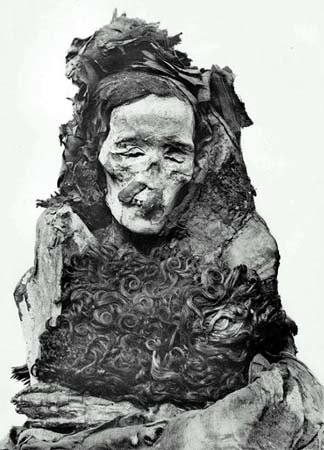
Ahmose-Hentempet
(c. 1574 B.C.)
17'th Dynasty
Provenance:
DB 320
Discovery Date: 1881
Current Location: Cairo Museum CG61062
Biographical Data
Details: The mummy of Hentempet had been
plundered by either ancient or modern thieves, who burrowed a large hole through
the outer shroud and wrappings in the area of the chest, probably in search of a
heart scarab or pectoral. G. E. Smith unwrapped the mummy of in June, 1909. He
uncovered the body of an elderly woman who had suffered considerable post-mortem
injury. Both her forearms had been broken off. The left forearm had been
repositioned across her the body, but only fragments of the right forearm
remain.
 Smith noted that the face had been distorted by heavy pressure, probably
unintentionally by the embalmers during the original wrapping of the mummy. The
pressure was great enough to squeeze the plugs of linen out of Hentempet's nose,
producing an effect which Smith describes as "gruesome." He also comments that
the face had not been adequately treated during the mummification process, and
describes the facial skin as being parchment-like and pale yellow in color, "as
though it had been painted with ochre." Smith's wording shows that he is not
quite certain whether ocher was used or not. Later female mummies often do have
their faces painted with yellow ochre, and perhaps Hentempet's mummy provides an
early experiment with this technique. Her teeth were well-worn and her hair was
liberally streaked with gray, indicating an advanced age at the time of death.
Unusually, the bandages in which Hentempet had been wrapped had not been coated
with resin as had the wrappings of most of the other mummies Smith examined from
this period. He found Hentempet's embalming incision in the usual location, and
notes that her vagina had been plugged with linen.
Smith noted that the face had been distorted by heavy pressure, probably
unintentionally by the embalmers during the original wrapping of the mummy. The
pressure was great enough to squeeze the plugs of linen out of Hentempet's nose,
producing an effect which Smith describes as "gruesome." He also comments that
the face had not been adequately treated during the mummification process, and
describes the facial skin as being parchment-like and pale yellow in color, "as
though it had been painted with ochre." Smith's wording shows that he is not
quite certain whether ocher was used or not. Later female mummies often do have
their faces painted with yellow ochre, and perhaps Hentempet's mummy provides an
early experiment with this technique. Her teeth were well-worn and her hair was
liberally streaked with gray, indicating an advanced age at the time of death.
Unusually, the bandages in which Hentempet had been wrapped had not been coated
with resin as had the wrappings of most of the other mummies Smith examined from
this period. He found Hentempet's embalming incision in the usual location, and
notes that her vagina had been plugged with linen.
A large and luxuriant wig was found covering Hentempet's chest, and another
wig, described by Smith as being like the coiffure of Lady Rai, was placed
crookedly on the left side of her head.
Hentempet was found in a replacement coffin dated to the 18'th Dynasty (see coffin #CG
61017at right.) It had been painted black, and the name of the original owner had
been replaced with that of Henttempet. (Source Bibliography: CCR, 24ff; DRN,
200, 206, 212; RM, 20.)
Other Burial Data:
Original Burial: Unknown.
Reburials: Reeves argues that Henttempet was moved into DB 320 with the other
mummies that had been cached in the k3y of Inhapi. He dates this event to
sometime after Year 11 of
Shoshenq I (Source:
DRN, 251.)
Photo Credit: photo of mummy RM, (Cairo, 1912,) pl. XVI; photo of coffin CCR, pl. XV. For high resolution photos of
Ahmose-Hentempet see the University of Chicago's Electronic Open Stacks copy of
Smith's The Royal Mummies (Cairo, 1912,) Call #: DT57.C2 vol59,
plates
XV,
XVI, and
XVII (which shows large wig flattened out.)

Ahmose-Sitkamose
(c. 1573-1570 B.C.)
17'th Dynasty
Provenance:
DB 320
Discovery Date: 1881
Current Location: Cairo Museum CG61063
Biographical Data
Details: The mummy of Sitkamose was unwrapped by
Gaston Maspero on June 19, 1886. She had been buried with a floral garland, and
an inscription appeared on her outer shroud. After removing this, Maspero
encountered another layer of bandages which had also been inscribed, indicating
the date on which Sitkamose had been rewrapped (see Linen Docket Translations
below.)
Beneath the bandages, Maspero discovered the mummy of a woman who had died
at approximately thirty years of age. G. E. Smith described her as "a large,
powerfully-built, almost masculine woman." Her mummy had been damaged by grave
robbers, who had cut away most of the anterior body wall in their search for
valuables. The left arm had been broken off at the shoulder, and the occipital
region of the skull had been crushed and was completely missing. A black,
resinous material coated the whole body, and in this dried substance remain
impressions of various items of jewelry that had been removed by the thieves.
Additional damage to the mummy was done by mice, who had gnawed the back of
Sitkamose's left thigh and her right gluteal fold.
Smith comments that the brain and its membranes are visible through the
large opening in the back of the skull. He states that the fact these were not
removed by the embalmers indicates the early date from which the mummy derives.
Sitkamose's nostrils had been filled with linen plugs, and her body cavity had
been packed tightly with the same material, some of it having been soaked in
resin. A large cake of resinous paste was employed to cover her perineum. Her
teeth are only moderately worn, and her hair had not yet turned gray at the time
of her death. Sitkamose's arms had been positioned so that her hands could rest
over the pubic region, and Smith comments that this is very unusual for mummies
of this period. Impressions remain on her toes of the strings which were used to
fasten the toenails in place during the embalming procedure.
 Sitkamose was found in the intact 21'st Dynasty coffin of a man named
Pediamun (see coffin #CG 61011. at right.) Reeves states that this man should probably not be
equated with the Pediamun named in the wall docket from DB 320 which
commemorates the burial of Pinudjem II. (There are two men named Pediamun listed
in this inscription. Reeves gives no reason for his assertion that the Pediamun,
who bore the titles "God's father of Amun" and "Chief of Secrets," was probably
not the man who originally owned the coffin in which Sitkamose was found.
Perhaps he believes such an attribution would be far too coincidental. He does
not mention the second Pediamun named in the wall docket, a man who was referred
to as a chief workman.) (Source Bibliography: CCR, 12ff; DRN, 200, 206, 213,
257;MR, 540ff.; RM, 21-22; XRA, 3C2-9 .)
Sitkamose was found in the intact 21'st Dynasty coffin of a man named
Pediamun (see coffin #CG 61011. at right.) Reeves states that this man should probably not be
equated with the Pediamun named in the wall docket from DB 320 which
commemorates the burial of Pinudjem II. (There are two men named Pediamun listed
in this inscription. Reeves gives no reason for his assertion that the Pediamun,
who bore the titles "God's father of Amun" and "Chief of Secrets," was probably
not the man who originally owned the coffin in which Sitkamose was found.
Perhaps he believes such an attribution would be far too coincidental. He does
not mention the second Pediamun named in the wall docket, a man who was referred
to as a chief workman.) (Source Bibliography: CCR, 12ff; DRN, 200, 206, 213,
257;MR, 540ff.; RM, 21-22; XRA, 3C2-9 .)
Other Burial Data:
Original Burial: Unknown.
Restorations: From inscriptional evidence found on her wrappings, Sitkamose was
rewrapped in Year 7 4 3ht 8 of
Psusennes I.
(Reeves gives the date of this event as Year 7, 4 3ht 18 on page 252 of
DRN. This does not correspond with the date he gives on page 236, Table
10, #28.)
Reburials: Reeves dates the transfer of Sitkamose from the k3y Inhapi
into DB 320 to sometime after Year 11 of
Shoshenq I. (Source:
DRN, 252, 258 .)
Type A Linen Docket"The king's daughter, king's sister and great king's wife
Sitkamose, may she live!" (Source Bibliography: DRN, 232; MR, 541 [facs.].)
Linen Docket: Year 7, 4 3ht 8 of Psusennes
I/'king' Pinudjem I/Menkheperre: "Year 7, 4 3ht 8. On this day osirifying
(dit wsir n) the king's daughter and great king's wife Ahmose-Sitkamose,
may she live!" (Source Bibliography: DRN, 236; MR, 541 [facs., transcr.]; RNT,
250 [11]; TIP, 420 [39].)
Photo Credit: RM (Cairo, 1912,) pl. XVIII. For high resolution photo of
Ahmose-Sitkamose see the University of Chicago's Electronic Open Stacks copy of
Smith's The Royal Mummies (Cairo, 1912,) Call #: DT57.C2 vol59,
plate
XVIII.